
Cape Breton University — nor its home of Sydney, Nova Scotia — is not the biggest community, but what they lack in population they more than make up for in passion for the beautiful game. That was perhaps more evident than ever from Nov. 9-12, as the island hosted the 2023 U SPORTS Men’s Soccer Championship for the first time in the competition’s 51-year history. Ness Timmons Field was host to eight of the best university teams from across the country, all battling to take the title that the Thompson Rivers WolfPack relinquished as a result of not making it through the Canada West playoffs. It was an intense week of action, especially for the host CBU Capers, who were looking to win their second national title (after winning their first in 2017), this time on home soil. “It was a whole week of goosebumps,” Capers head coach Deano Morley said to CanPL.ca. “I remember that first game, the quarter-final, I’ve never in my life as a coach felt such immense pressure, because I could feel the uprising of the community and we wanted to deliver so bad. We were missing three key players, and we’ve worked so hard to put a plan together, that then as a coach you’re just praying that it goes out and delivers, and they really did.” In that quarter-final match against the UQTR Patriotes, a first-half brace from Owen Sheppard looked to be enough to put the hosts through to the semifinals, but the RSEQ finalists mounted a late comeback. Former Halifax Wanderers attacker Vincent Lamy scored in the 77th minute to pull one back, before Mahdi Abbassi scored in the dying stages of the match. Penalties would be needed to decide the winner. While the Capers scored on all four of their shots, Lamy and Samuel Laplante missed for the Patriotes, sending CBU through to the next round. “It did something much more than just put us in the semifinals, you felt it right after that whistle, you felt the community buy in, you felt them say we’re a part of this,” Morley said. “We went back to the campus bar for a reception after that game and we walked in, and I was blown away by the people and the energy and the excitement. From that moment, I enjoyed it. The pressure left, and it was about this togetherness, and it was coming from every angle.”
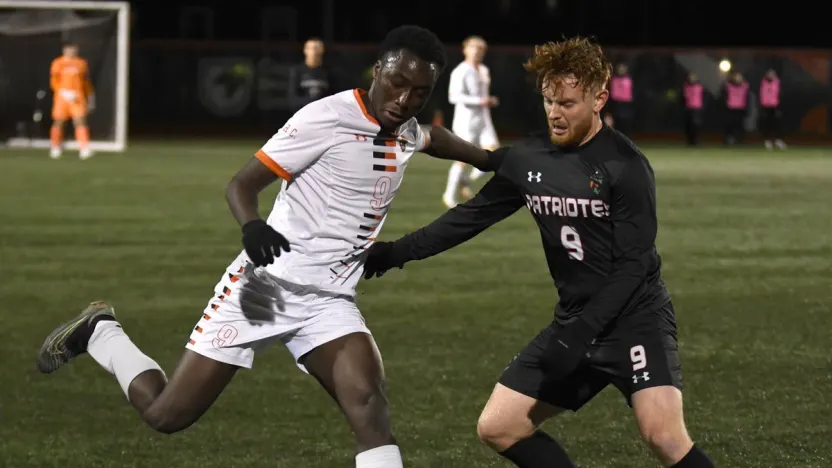
In the next round, CBU took on the Mount Royal Cougars, the Canada West champions who had beaten the York Lions 1-0 the day before. The Cougars, playing in their first-ever national championships in men’s soccer, put up a strong fight, but ultimately it was another goal from Sheppard that saw the Capers move on to the final — this one a low, driven shot from the edge of the box that found the bottom right corner.
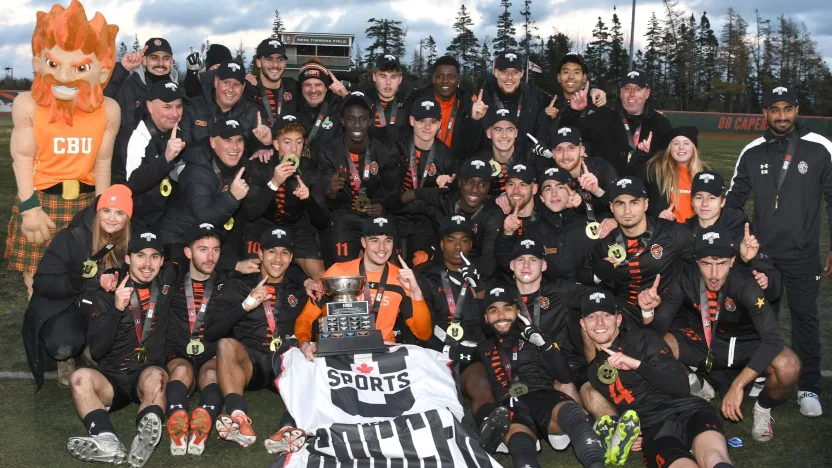
That win set up a rematch with the Montreal Carabins, who CBU were up against in both the 2017 national championship game that they won, and the 2018 final that the Carabins won. This time, just like it was in Kamloops, B.C. exactly six years earlier, it was the Capers that came away with U SPORTS’ ultimate prize. Sophomore midfielder Jacob Spizzirri was the hero for the hosts, scoring the lone goal in first half stoppage time. He picked up the loose ball in the box, set his feet, and fired the ball past Carabins goalkeeper Olivier Rouleau, before charging toward the hometown fans that were sent into a frenzy behind the net.
Montreal couldn’t find an equalizer after the break, and the Capers held on for their second national title in program history. After losing the Atlantic University Sport (AUS) title to the St. Francis Xavier X-Men, the Capers wouldn’t be denied the next time around, completing another strong season top of the U SPORTS pile. “I think we had over 1,300 fans there for the final, but they sounded like 10,000 fans,” Morley said. “The videos and the images at the end of the game, of them kicking down the barriers and running onto the field and mauling us, and then for me personally and my coaching staff to do this at home, being able to go hug my wife, to be able to pick my daughter up, to have her in the picture, that will last forever. “I’m very proud of my team,” added midfielder Max Piepgrass, who was credited with an assist on the championship-winning goal. “From where we started in England in preseason, I feel like the principles that we laid out, the things that we wanted to do, we did it. We really came together when we lost the AUS final, I feel like we became a team that’s unbeatable… we became stronger. That pushed us to prove something. “It was really huge for us having the whole island supporting us. I’ve had people come up to me on the street saying, ‘You don’t know how big this win was for the island’, and I feel like because we showed hard work, determination on the field, the people of Sydney, of Cape Breton, notice that and they wanted to come and support that hard work and determination.”
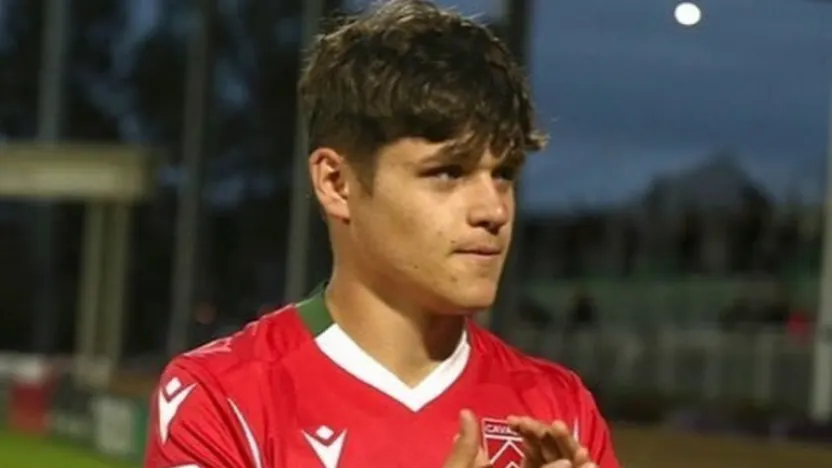
As Piepgrass — who made two appearances for Cavalry FC as a 17-year-old in 2021 — alluded to, this was a long journey that started overseas back in the summer. CBU took a preseason trip to England, where coach Morley is from, and spent some time watching and playing games in a high-performance, professional environment thanks to a relationship with Leicester City FC. While over there, they saw some of the top teams in the English Premier League play, including Manchester City, Newcastle United and Liverpool, as well as Sheffield United and lower division sides Derby County and Leeds United. They also had the opportunity to train with some top coaches, including former Leicester and Liverpool midfielder Kevin MacDonald, and play matches against Mansfield Town, Fleetwood Town and Blackburn Rovers. “We went some incredible stadiums,” said Morley. “We were at the Etihad Stadium, we were at Anfield, and then we were in the away end for West Brom versus Leeds at Leeds’ ground, so they were exposed to the history of football grounds, new grounds, and they had a great mix of training sessions and professional settings.” The valuable experience is one that doesn’t come cheap, and it’s that kind of investment that Ben Steiner, a U SPORTS reporter for CBC and 49 Sports, says makes all the difference at the U SPORTS level, and can set teams up for long-term success like CBU have had in recent years. “I think a lot of the focus has to be on the fact that they’ve just given investment toward their soccer program,” Steiner said in an interview with CanPL.ca. “They provide that soccer program with a lot of the financial ability to take recruiting trips to look at athletes outside of their immediate area in Cape Breton. They used to have more sports at Cape Breton University, they used to have a men’s hockey team for example, but they really focus on soccer now, and that’s become a piece to be proud of for that university. That student body, they really do get out and support that team quite a bit. “It’s deserved to win the national title for CBU, that’s a program that’s built up so well over the last several years. It’s a small school, but it’s a premier program in U SPORTS soccer. There’s a lot of people that, before U SPORTS soccer, hadn’t necessarily heard of Cape Breton University, but they’ve really put this small dot in Sydney, Nova Scotia on the map nationally, and they’ve made their mark on the CPL throughout the years as well.” That investment also comes in the form of facilities and full time staff members at the university that some schools don’t offer, including a full time academic success coach, a full time strength and conditioning coach, a mental strength coach, a full physio and medical team, and a handful of coaches. “If you want to be in a place where 30 seconds away from the stadium you’re living in your apartments together as a team, with your teammates next door, these lads are together 24/7,” Morley said. “It’s not like they just show up for practice and games and then disappear, we’re tight and we do everything together, so when you have that, you can manage it, you can control it, you can implement your ideas.” For the student-athletes, it’s important to remember that first part as well as sports — they are students and academics are vital to the U SPORTS experience. “When I came for my visit, I just fell in love instantly with the island, it’s such a special vibe here,” said Piepgrass. “All the guys live in one building so you get connections with friends that can last a lifetime. It’s a very special setup, a very professional setup as well. The field is a 10-second walk… you can always put the work in when you’re already here. “With the team, we have a good mix of age, so if I’m struggling on an assignment while we’re on a ten-hour bus drive, I have an older player that can help me with my assignment. I definitely feel like it takes balance, you have to balance your time, but also help from other people definitely helps.”
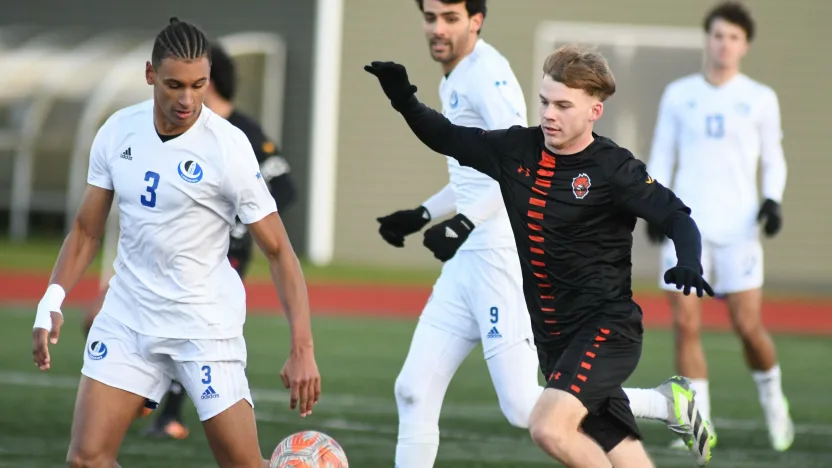
The opportunity to play for the Capers, and represent Cape Breton Island as a whole, is not one that Morley just hands out to anyone. As a former player at CBU, turned assistant coach and eventually head coach, Morley bleeds Capers orange, and wants his players to be fully immersed in the community that has become his home over the past 20 years since first joining as a player in 2004. “I ask them through the [recruitment] process why they feel they deserve the opportunity to come and represent Cape Breton Island,” he said. “I believe in this island, I believe in the people here, and believe in what we’ve had to face is an island with with industries collapse, and it’s a very resilient place. “Because it’s a tight knit community, it’s a small university, and if people aren’t holding up their end of the deal of what it takes to be a keeper, then I’m able to step in quickly and I think that that keeps us where we need to be.” While at the helm of CBU, he has coached several players that went on to be difference-makers in the Canadian Premier League, including Peter Schaale, Isaiah Johnston, Cory Bent, Kairo Coore, and more. With the 2023 CPL-U SPORTS Draft coming up in mid-December, there is a strong chance that more CBU players have their names called by CPL clubs this year. As the program continues to evolve, and especially if they can build on all of their success from the past decade or so, Morley’s hope is that it can continue to be a key part of developing players for the CPL, and eventually the national teams. But things didn’t always look so bright at CBU. “When I arrived in 2004, we were officially the worst ranked team in Canada,” Morley said with a smile. “It wasn’t too enjoyable that first year, I think we got pounded everywhere we went. We never felt we could go to Halifax and beat a Saint Mary’s or beat a Dalhousie. We never felt that we could make playoffs and we did that, and then we wanted to win a playoff game and we did that, and then we made an AUS final and lost, and then we started to believe in what we were doing, then worked even harder. “In 2007, when we won the first AUS championship, it was our first trip to nationals and we arrived like deer in headlights, we didn’t know what to expect — everyone looks so big, so professional, so well acclimatized. We didn’t know what to do, so then it was a case of ‘Okay, can we win a first game at nationals? Can we get into semifinals?’. Then when we won our first bronze medal, again we went through that process of saying ‘We belong, we can do this’, and in 2012 we made the national final and lost in a heartbreaker in the final to win silver, but that silver propelled the rest of history.” Morley’s story is one of hard work and determination, but also of love for this sport and the development of both good players and good people. He told CanPL.ca that no matter how many national championships they win, he will always aspire for better things for Cape Breton University. “I want become one of the best programs in North America for young Canadian players to want to be at, to want to develop,” he said. “I want to be a part of the pathway for Canadian football, I believe in the CPL and I know that it’s not about the talent that we recruit, I honestly believe it’s about the culture and the environment that we expose the talent to that is going to produce players who are ready to go into the men’s dressing room at the CPL level and handle it, and handle the pressure, and handle the standards, and do well. That’s that’s our ambition here, and I feel very lucky to be a part of that.” Piepgrass pointed to Cavalry FC’s Eryk Kobza as a prime example of what can happen if a player performs at the U SPORTS level and earns themself a spot in the professional game. After a few strong years with the University of Calgary Dinos, Kobza was drafted by Cavalry FC last year, and become a cornerstone piece of the team, making 29 appearances between the regular season and playoffs. Kobza also signed a professional contract after initially being on a development contract, keeping him with the Cavs through 2025 with an option for 2026. “It’s cool, because you definitely see the pathway… I feel like it gives people confidence that if they do perform at the U SPORTS level, they can make it pro,” said Piepgrass. “That was a problem maybe a couple years ago, when, say, if you do perform in U SPORTS, you’re unsure what to do next, maybe you have to go overseas or whatever. “With the U SPORTS to CPL pathway, it gives people an opportunity and I feel like if they take the opportunity, there’s a big chance for them to make something big in their own country.” Having made those two brief appearances with Cavalry in 2021, and had a strong year with CBU, Piepgrass is keen to get back into that professional environment again as soon as possible. This past summer he played for Calgary Foothills in the 2023 League1 Alberta Exhibition Series, alongside some other players who have played for the Cavalry FC first team, including Tom Field, Markus Kaiser, and Skyler Rogers. After an injury the year before, Piepgrass enjoyed his football again, and feels like he’s ready to make the jump back up. “I got a little taste when I was 17,” he started. “After my injury, I’ve just been really wanting to get back in that pro environment, and coming to Cape Breton really gives me the confidence and a place to just play and enjoy my football. “I feel like I’m hungrier than ever to get back in that pro environment, but I’m also aware of how much sports has given me, and it’s given me a platform to showcase my ability. The coaching staff at Cape Breton have been really patient with me through my injury last year, and now that I was at my top game this year, I feel like it’s definitely pushed me to want to get back to pro as soon as possible.” He credits a lot of that success this year to his head coach in Cape Breton. “It’s a very special bond,” he said of their relationship. “I came in last year injured, he didn’t really know anything about me and then we kind of got a relationship away from football. Then this year, I feel like we really bonded on football, personal and everything. “He means a lot to me, he showed patience in me, he showed confidence when no one else did.”
Players aren’t the only factor in this pathway. Coaches, administrators, referees, and more are all being given opportunities like never before in this country. With that comes a new ambition for Morley — to coach at the professional level, potentially in the Canadian Premier League. “My ambition burns bright, I love what I do,” Morley said. “For me, it’s a case of it’s not just about me, it’s about my family, and I’ve got an 11-year-old daughter who means more to me than maybe anything. It will be a case of putting my family, my wife and my daughter, into the consideration where my ambition doesn’t overtake my family responsibility and the time that I have for them. “It’s a balance, but I look at it and I say, ‘Yeah, I could do that’, and it’s hopefully at the right time, in the right place, with the right club, that equals my levels of of desire to win and ambition. I’m not very good at just taking part, I want to be the best, so I think it’s all about timing and opportunity, and family balance.” For now, however, the CBU gaffer is committed as ever to the future of the Capers, and of U SPORTS’ role in the Canadian soccer pathway he values so highly. “I want to continue to help push is the belief I have in the university coaches and programs in Canada, and there are some excellent ones across this country,” he said. “U SPORTS is a massive piece of this engine, and we need to get behind it. Hopefully the national program and Canada Soccer continues to get behind this pathway, grows it, supports it, and that together in Canada, we move football forward instead of in silos or in isolation, or just in certain provinces. “It needs to be better connected, and that’s that’s sort of my drive on something that I believe in, and I want to continue to help that that narrative grow.”